
SEO, AEO and GEO: what they mean for your business.
Learn what SEO, AEO and GEO mean, how they overlap, and how useful content can support discovery through search results and AI-generated answers.
Talk about your project ↗By webdastak editorial team · Updated 10 November 2026
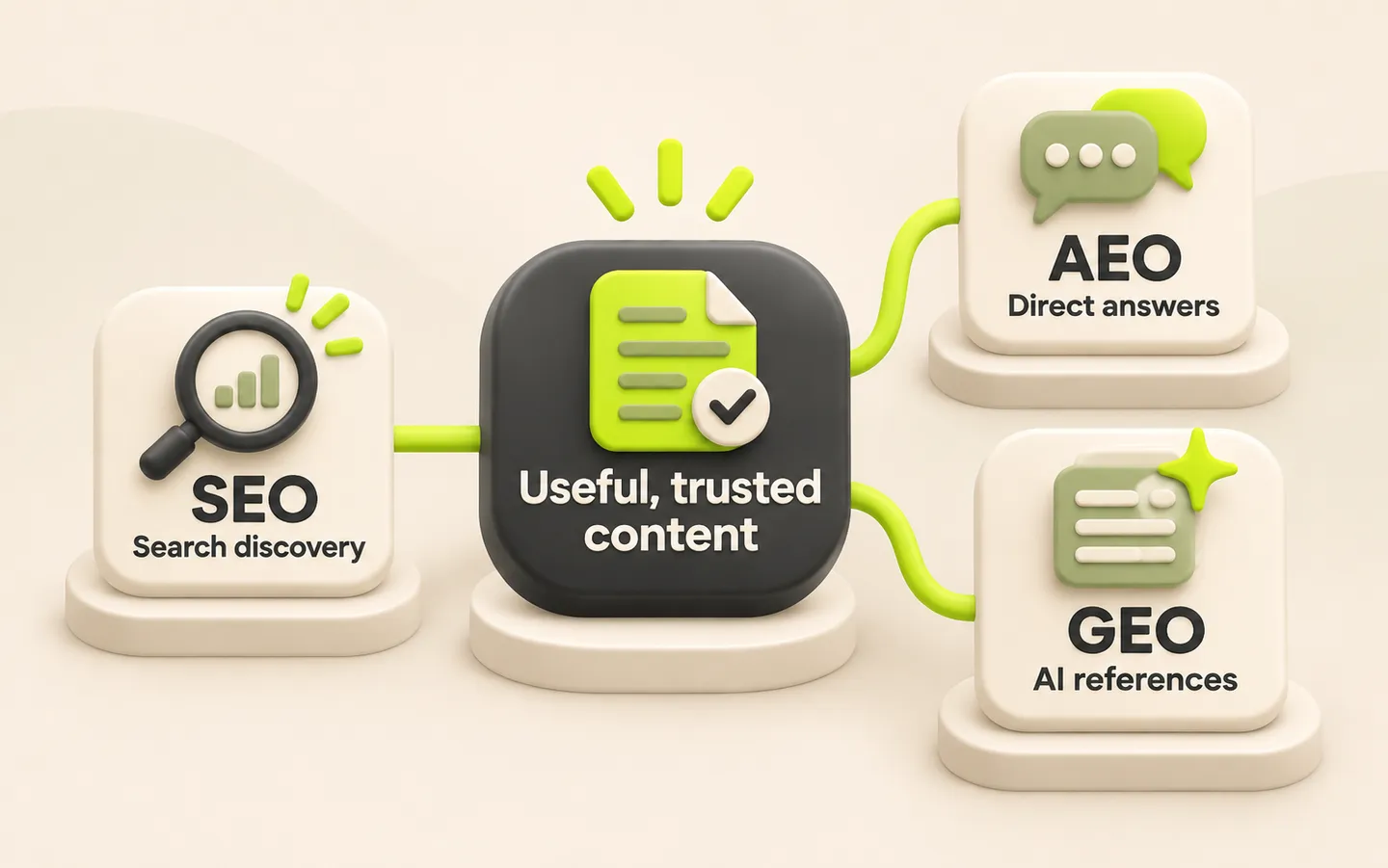
What are SEO, AEO and GEO?
SEO means search engine optimization. AEO means answer engine optimization. GEO means generative engine optimization. All three describe work that helps people discover and understand your business online. SEO covers visibility in search engines; AEO emphasizes clear answers to questions; GEO considers how content may be used or cited in generated responses. The terms overlap and are not standardized service categories, so ask a provider to explain the actual work behind each label.
What is SEO?
Search engine optimization improves how a website can be discovered, understood and presented in search results. It includes technical access, useful content, descriptive page titles and links between related pages. For a business, the starting question is practical: which pages help a potential customer understand an offer and decide whether to enquire? A service page should explain who the service is for, what it includes and how to take the next step.
- Technical SEO: crawlability, indexing, redirects and site performance
- On-page SEO: headings, titles, useful copy and internal links
- Content planning: matching pages to real customer needs
- Local information: accurate contact details and service coverage
What is AEO?
Answer engine optimization focuses on making information useful when someone asks a direct question. That might mean a concise definition, a step-by-step explanation or an answer to a buying question. For a rental business, a customer might ask which documents are needed to hire a car. An answer should explain the actual policy, relevant exceptions and where to confirm details. A short response can introduce the answer, with enough detail afterwards to prevent misunderstanding. Clear wording helps readers; it does not guarantee a featured snippet or assistant recommendation.
What is GEO?
Generative engine optimization considers whether content is discoverable and useful as a source for AI-generated responses. A generated answer may combine information from several pages rather than send a visitor directly to one result. Bing describes GEO in terms of eligibility for grounding and reference in AI responses. In practice, review whether a page states its subject clearly, distinguishes evidence from opinion and provides enough context to support its claims. GEO here means generative engine optimization, not geographic targeting; local SEO addresses location-based searches.
How do SEO, AEO and GEO work together?
Think of these as overlapping priorities in one content strategy. SEO helps establish the website and its pages in search. AEO asks whether the page answers a specific question clearly. GEO asks whether information can be understood and referenced in a generated response. Google says its existing SEO practices also apply to AI Overviews and AI Mode, with no special optimization requirement. Keep technical access and helpful, reliable content at the centre of the work rather than treating AI visibility as a separate shortcut. The connected illustration above is a conceptual guide: these practices support several goals, rather than belonging exclusively to one category.
- SEO + AEO: question-led content connects a search query with a clear answer. A service page can explain what is included and answer the questions customers ask before enquiring.
- SEO + GEO: discoverable sources give search systems and AI systems useful pages to find and reference. Review technical access, internal links, accurate business details and supporting evidence.
- AEO + GEO: reusable answers make a specific point clear with enough context to avoid ambiguity. Explain definitions, conditions and sources so an answer remains useful when summarized.
- All three: useful, trustworthy content starts with real customer needs, accurate facts and clear explanations. One well-maintained page can support search discovery, direct answers and AI references.
Example: one useful page for a car rental business
Imagine an Islamabad rental company preparing a page about airport pickups. Before drafting, its team confirms the booking process, pickup area, flight-delay policy and documents required. The page can then serve several needs without creating duplicate versions for each acronym. This is an illustrative content plan, not a claim about rankings or AI citations.
- SEO: give the airport-pickup service a clear page title and link it from relevant rental pages
- AEO: answer questions such as how to arrange a pickup and what happens if a flight is delayed
- GEO: explain the actual policy with accurate business details and clear conditions
- Conversion: provide a booking or enquiry action that collects the details staff need
What should a combined service include?
Ask for a written scope tied to your website and audience. A small company may first need accurate service descriptions and working contact routes. A larger catalogue may need page mapping and technical repairs before more articles. Agree who approves business facts, who makes website changes and which pages will be reviewed. Useful deliverables make it easier to assess a proposal than a promise to optimize for every platform.
- A baseline audit and prioritized implementation plan
- Customer questions mapped to relevant service pages and articles
- Content revisions with clear definitions, examples and supporting sources
- Structured data where appropriate and consistent with visible content
- A reporting plan that connects discovery with useful enquiries
How can you measure progress?
Record a starting point before changes. Track completed work, relevant search visits and the enquiries your team receives. Review AI referrals when analytics identifies them, and keep any manual answer checks consistent: record the question, date, platform and observed response. Such checks are a sample, since generated answers can change. A mention alone does not show that someone became a customer. Review lead quality with the people handling enquiries before deciding which content to improve next.
Do AEO and GEO replace SEO?
They are useful perspectives on discovery, but the labels alone do not define a strategy. Start by making your business easy to understand and your content worth reading. Then improve the pages that answer customer questions and assess how they appear across the discovery channels relevant to your audience. webdastak includes AEO and GEO within its SEO service scope, with agreed deliverables and reporting. Search engines and AI systems decide what they show; rankings, traffic, citations and enquiries cannot be promised.
Before we get started.
01What is the difference between AEO and GEO?
AEO emphasizes clear answers to user questions. GEO emphasizes content that may inform or be referenced in AI-generated responses. Their activities overlap, and providers use the terms differently, so compare deliverables.
02Does structured data guarantee AI visibility?
No. Use applicable structured data that accurately reflects the visible page. It does not guarantee a search feature, AI citation or recommendation.
03Where should a small business start?
Check technical access, accurate service and contact information, and the questions customers ask before buying. Prioritize useful pages and a working enquiry journey, then measure what changes.